Search for Snapjotz com and the results become confusing quickly. Some pages describe a publishing website. Others talk about digital notebooks, AI workspaces, multimedia tools, or automated meeting notes.
The current evidence points in a simpler direction. Snapjotz com is presently indexed as a multi-niche content and news website, with recent articles appearing on the domain in September 2026. Independent reviews examining the exact .com address also describe an article-based publication rather than a documented software product.
This guide focuses on what can actually be verified, how readers should use the site, and why similarly named domains need to be treated separately.
What Is Snapjotz Com?
Snapjotz com is the search-friendly form of Snapjotz com, a website currently structured around informational articles covering multiple subjects.
The official domain is indexed under the title “Snapjotz Official Site | Multi-Niche Insights & News.” Recent search data also shows dated posts and category-based content. That structure fits an online publication more closely than a conventional SaaS platform.
A simple view of the current experience looks like this:
Search or direct visit → Choose an article or category → Read the content → Check its evidence → Verify important claims independently
There is an important distinction here. A separate domain, snapjotz com, currently presents itself as an AI meeting-notes service with transcription, summaries, action-item extraction, and integrations. Those features should not automatically be attributed to the exact Snapjotz.com domain.
Why Is Snapjotz Com Important?
Understanding the website correctly matters because the name appears in several different contexts across search results.
- Readers avoid wrong expectations. Someone looking for a downloadable productivity application may actually land on an editorial website.
- Researchers can identify the correct source. Similar brand names do not prove common ownership.
- Searchers get cleaner information. Exact-domain checking prevents features from one website being assigned to another.
- Writers reduce factual errors. Repeated claims found across blogs are not automatically verified facts.
- Businesses can perform better due diligence. Website structure, ownership information, editorial standards, traffic claims, and commercial opportunities should be evaluated separately.
The biggest value is clarity of identity. A domain should be judged by what it currently provides, not by what unrelated articles claim it provides.
Quick Reference Matrix
| Core Element | Action / What it Involves | Primary Goal / Output |
|---|---|---|
| Domain identity | Check the exact .com address | Avoid brand confusion |
| Content structure | Browse dated posts and subject areas | Find relevant reading |
| Article quality | Inspect sourcing, specificity, and authorship | Judge usefulness |
| Freshness | Check publication and update dates | Avoid stale guidance |
| Claim verification | Compare statements with primary sources | Improve accuracy |
| Site policies | Review available legal and contact pages | Understand publisher practices |
| External references | Separate independent evidence from promotional claims | Build context |
How to Evaluate and Use the Website Properly
1. Start With the Exact Domain
Do not evaluate a website from its brand name alone.
Check the address in your browser. Snapjotz.com, Snapjotz.org, Snapjotz.net, snap-jotz.com, and snapjotzcom.com are different domain names. Similar spelling does not prove that their content, owners, features, or policies are connected.
This matters especially here because search results currently attach several very different descriptions to the Snapjotz name.
2. Examine the Page Before Reading Deeply
A useful article should establish its subject quickly.
Check:
- Publication date
- Author information
- Category
- Main claim
- Supporting sources
These details tell you whether the page is a timely explainer, general commentary, commercial content, or something that deserves additional verification.
A polished layout alone tells you very little about factual reliability.
3. Match the Article to Your Search Intent
A multi-topic publication can serve very different readers.
Someone searching for a basic technology explanation needs something different from a reader researching health, finance, education, or a company. Decide what level of evidence your question requires before treating an article as sufficient.
Low-risk informational topics may only require a clear explanation. Decisions involving money, health, law, security, or major purchases demand stronger sources.
4. Follow the Evidence, Not the Writing Style
Good formatting makes information easier to consume. It does not make a claim true.
Look for named organizations, official documents, direct statements, dates, data sources, research papers, or clearly identified references when an article makes specific factual claims.
If an article says a platform has millions of users, offers a particular feature, or reached a certain valuation, ask one question:
Where did that number come from?
No source means the figure should remain unverified.
5. Check Whether the Information Is Still Current
Websites change quickly.
Features disappear. Companies rebrand. Privacy policies change. Domains change owners. Pricing gets updated. Old reviews can remain indexed long after the underlying service has moved on.
For rapidly changing subjects, compare the article date with the date of the official documentation or announcement it references.
6. Use Primary Sources for Final Verification
A general publication can be useful for discovery.
The final verification should often happen elsewhere.
| Type of Claim | Stronger Source |
|---|---|
| Software feature | Official product documentation |
| Company information | Official company page or filing |
| Medical guidance | Recognized health authority |
| Financial rule | Government or regulatory source |
| Research finding | Original study |
| Product specification | Manufacturer documentation |
This method turns a general article into a starting point instead of the entire research process.
Industry and Use-Case Specific Scenarios
For Everyday Readers
A multi-category site works well when the goal is orientation.
A reader encountering an unfamiliar topic can use an article to understand vocabulary, identify important concepts, and decide what to research next. That is different from using the page as definitive professional advice.
For Students
Students can use general publications to build background knowledge before moving to academic material.
The strongest approach is to identify names, concepts, dates, studies, or organizations mentioned in an article and then locate the original sources. General web articles normally should not replace peer-reviewed evidence when a course requires scholarly references.
For Content Researchers
Writers can use the publication for topic discovery and search-intent research.
Headings, reader questions, related terms, and category structures can expose useful angles. Facts should still be independently sourced before being republished.
For Marketers and Brands
Marketers evaluating a website should look beyond visual appearance.
They may need to examine topical relevance, publishing consistency, indexing, editorial quality, audience alignment, link practices, and historical stability before deciding whether the publication fits a campaign.
That evaluation is different from determining whether one individual article gives a good answer.
Snapjotz.com vs. the Similarly Named AI Meeting Site
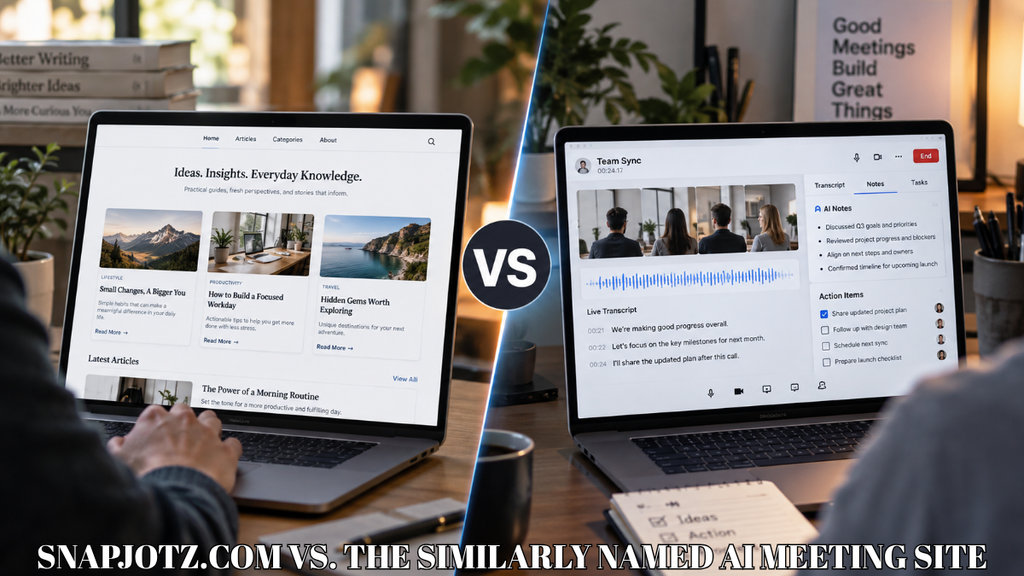
The naming overlap is one of the main reasons conflicting descriptions appear in search.
| Factor | Snapjotz.com | snapjotzcom.com |
|---|---|---|
| Current presentation | Multi-niche content/news website | AI meeting-notes service |
| Main public output | Published articles | Transcripts and summaries |
| Core interaction | Reading content | Processing meetings |
| Meeting transcription | Not established for the exact domain | Explicitly advertised |
| Action-item extraction | Not established | Advertised feature |
| Integrations | Not clearly documented as a core .com service | Slack, Notion and Jira are promoted |
| Primary use case | Information discovery | Meeting productivity |
The AI service specifically advertises recording, transcription, meeting analysis, action-item creation, and distribution to workplace tools. Those claims appear on snapjotzcom.com, not the exact Snapjotz.com address.
Domain spelling matters.
Common Mistakes and Best Practices
Common Mistakes to Avoid
- Treating every Snapjotz-branded domain as one business. Similar names can belong to completely separate websites.
- Copying product features from third-party articles. A feature should be visible in first-party documentation before being presented as established fact.
- Assuming Google snippets tell the whole story. Search snippets are shortened representations and can lag behind site changes.
- Judging authority from design quality. Professional typography, graphics, and navigation do not establish expertise.
- Using third-party SEO metrics as editorial proof. Traffic estimates, authority scores, and backlink statistics measure different signals from factual reliability.
- Treating an old review as a current product description. Websites can change purpose without every old article disappearing from search.
How to Maximize Research Efficiency
- Search exact phrases in quotation marks when tracing where a claim originated.
- Open the source behind statistics instead of quoting an intermediary article.
- Record dates alongside facts when researching changing products or websites.
- Separate publisher statements from independent observations in your notes.
- Look for corrections or update notices on older material.
- Compare several independently written sources when first-party information is incomplete.
- Save the exact domain name with every research note when multiple similar brands exist.
Those habits remove a surprising amount of online misinformation.
Future and Modern Trends
Website identity is becoming harder to manage as AI-generated search summaries and large-scale content publishing expand.
Search systems increasingly try to understand entities rather than individual keywords. When several domains use nearly identical names, weak source attribution can cause information from one property to appear connected with another.
Publishers will need stronger identity signals.
Clear About pages, author profiles, structured data, consistent branding, original reporting, transparent corrections, and primary-source references can help search engines and readers understand who produced a piece of information.
Content depth is also becoming more important. Publishing another generic definition offers little value when search engines can summarize dozens of similar pages instantly.
The competitive advantage is shifting toward first-hand evidence, original data, clear sourcing, useful examples, specialized expertise, and genuinely updated material.
For multi-topic publications, that raises the bar even further. Broad coverage needs strong editorial control if readers are expected to trust information across unrelated subjects.
Practical Checklist
Use this before relying on an unfamiliar article:
- Confirm the domain spelling in the address bar.
- Identify the publication or update date.
- Look for a real author or editorial attribution.
- Separate reported facts from opinions.
- Trace important numbers to their original source.
- Check whether screenshots or examples represent the current version.
- Treat anonymous testimonials cautiously.
- Review privacy terms before submitting personal information.
- Search for independent coverage when a claim sounds unusually strong.
- Use professional or official sources for high-stakes decisions.
Final Thoughts
The clearest way to understand Snapjotz com in 2026 is to focus on the exact domain and its observable purpose. Current search evidence identifies Snapjotz.com as a multi-niche insights and news website, while multiple independent examinations describe it as an article-based general-interest publication.
The confusing part is the wider web around the name. Similar domains advertise completely different services, including AI meeting tools. Readers who check the URL, date, source quality, and underlying evidence can avoid most of that confusion.
Frequently Asked Questions
Is Snapjotz Com a note-taking app?
The exact Snapjotz.com domain is currently indexed as a multi-niche content and news site. Some similarly named websites and third-party articles describe note-taking products, but those descriptions should not automatically be assigned to the .com domain.
Does Snapjotz Com have an official mobile app?
Current research did not establish an official mobile application belonging specifically to the exact Snapjotz.com content website. An app-store listing should be verified through the publisher’s official site before installation.
Do readers need an account to access articles?
Recent independent reviews describe the site as a conventional editorial publication where visitors browse publicly available content rather than entering a personal workspace. A current page should still be checked if login requirements change.
Who owns Snapjotz.com?
Public search results reviewed for this guide do not provide enough reliable first-party evidence to make a definitive ownership claim. Author names, reseller listings, and similarly named domains should not be treated as proof of legal ownership.
Is Snapjotz.com safe to visit?
Being publicly indexed does not by itself prove that any website is completely safe. Keep browser security enabled, avoid entering sensitive data without understanding why it is requested, and review the site’s current privacy information before submitting personal details.
Why do search results describe Snapjotz differently?
The name is used by multiple similarly spelled domains, while third-party articles also contain conflicting descriptions. One separate site, snapjotzcom.com, explicitly promotes an AI meeting assistant, which helps explain why AI and transcription features sometimes appear in searches around the name.
Can Snapjotz.com be used as a source for research?
It can serve as a starting point for general research, especially when an article helps identify terminology or relevant entities. Claims involving health, money, law, security, scientific research, or other high-stakes subjects should be confirmed through primary or authoritative sources.
Disclaimer: This article is provided for general informational and educational purposes only. The information is based on publicly available sources and research conducted at the time of writing. Website features, ownership details, policies, services, or other information may change over time. We are not officially affiliated with, endorsed by, or connected to Snapjotz com unless clearly stated. Readers should verify important information directly from official or trusted sources before making any decisions.