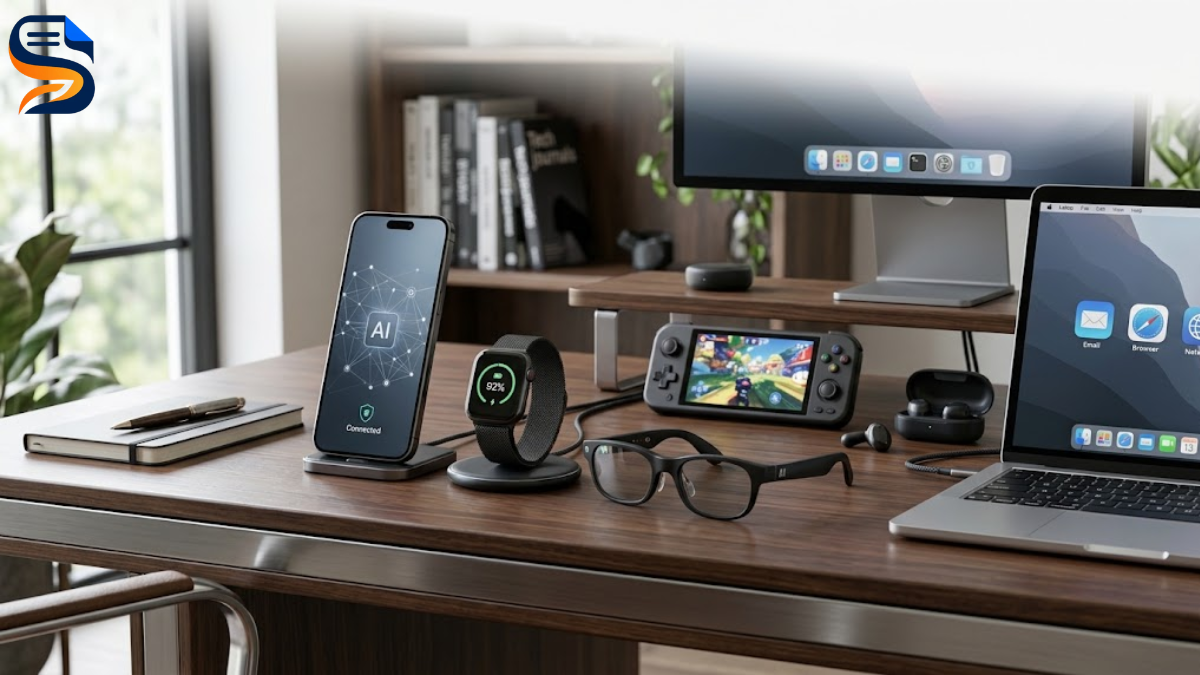
Droven.io New Gadgets 2025: Complete Guide to Smart Devices, AI Hardware, and Better Buying Decisions
The droven.io new gadgets 2025 search is easy to misunderstand. Droven.io is not a consumer-electronics manufacturer with its own phone, smartwatch, laptop, or gadget catalog. Its official site presents it as an editorial platform covering artificial intelligence, emerging technology, startups, development, robotics, and future technology.
That distinction matters. The useful way to approach droven.io new gadgets 2025 is as a research topic covering the devices and technology shifts that defined consumer hardware during 2025.
For buyers, students, tech enthusiasts, creators, and business users, the bigger question is simple: which new device features actually changed daily use, and which were mostly specification upgrades?
What Is Droven.io New Gadgets 2025?
Droven.io new gadgets 2025 refers to the broader search interest around modern gadgets, smart devices, AI-powered hardware, wearables, computing products, and emerging consumer technologies connected with Droven.io-style technology coverage.
There is no verified official “Droven” hardware collection behind the phrase. Droven.io describes itself as a technology and AI publishing platform rather than a device maker.
The practical research flow looks like this:
Technology trend → Relevant device category → Real product → Feature verification → Compatibility check → Cost assessment → Buying decision
That order prevents a common problem: choosing hardware because the feature sounds impressive before checking whether it solves anything useful.
Why Is Droven.io New Gadgets 2025 Important?
The 2025 hardware cycle marked several noticeable changes in consumer technology:
- AI moved deeper into hardware. Smartphones began combining dedicated silicon, local models, cloud intelligence, cameras, voice input, and cross-app actions.
- Multimodal interaction expanded. Modern devices increasingly process combinations of text, photographs, speech, video, and screen content.
- Wearables became less passive. Watches and glasses moved beyond notifications toward health interpretation, translation, recording, and contextual assistance.
- Gaming hardware received a major refresh. Nintendo introduced the Switch 2 as a new generation rather than another minor Switch revision.
- Software became part of hardware value. A powerful processor means less if useful features disappear, require subscriptions, or stop receiving updates.
- Privacy became harder to separate from functionality. Cameras, microphones, location sensors, health information, and AI processing increasingly coexist inside the same device.
- Ecosystems gained more influence. A gadget’s usefulness now depends heavily on how it communicates with phones, accounts, accessories, cloud services, and existing applications.
Quick Reference Matrix
| Core Element | Action / What It Involves | Primary Goal / Output |
| AI smartphones | Combine cameras, voice, apps, search, and generative models | Faster everyday assistance |
| Smart wearables | Capture activity, sleep, communication, and sensor data | Persistent personal computing |
| AI glasses | Put cameras, microphones, audio, and assistants at eye level | Hands-free interaction |
| Portable gaming | Merge mobile hardware with stronger console-level experiences | Flexible entertainment |
| Connected accessories | Link peripheral hardware with larger device ecosystems | Reduce workflow friction |
| Edge processing | Run selected intelligent workloads directly on hardware | Lower latency and greater device autonomy |
How to Evaluate the Droven.io New Gadgets 2025 Landscape
A gadget should be evaluated as a complete system, not a list of specifications. Six checks reveal far more than a marketing page.
Step 1: Define the Exact Job the Gadget Must Perform
Start with the problem.
Don’t begin with a brand name or processor.
- Write down one primary use case.
- Identify where your current device fails.
- Define the improvement you expect.
- Separate convenience from actual necessity.
- Reject features unrelated to that job.
For example, someone recording hands-free travel footage has a different requirement from a user who simply wants notifications without reaching for a phone.
One device does not need to solve everything.
Step 2: Check Ecosystem Compatibility Before Specifications
Modern hardware rarely operates alone.
A smartwatch may depend on a specific mobile operating system. Smart glasses may require a companion application. Gaming devices can depend on particular libraries, memberships, or accessories.
Check these four areas before purchase:
| Compatibility Check | What to Verify |
| Operating system | Supported Android, iOS, Windows, macOS, or proprietary versions |
| Account requirement | Whether a manufacturer account is mandatory |
| Accessory support | Chargers, controllers, docks, straps, storage, cases |
| Data portability | Whether files and information can leave the ecosystem easily |
The cheapest gadget can become expensive when replacing your existing accessories and services becomes necessary.
Step 3: Separate On-Device AI From Cloud AI
“AI-powered” tells you almost nothing by itself.
Find out where the processing happens.
On-device processing can offer faster response times and continue supporting selected functions without constantly transmitting the workload to remote infrastructure. Cloud processing can handle heavier models but depends more heavily on connectivity and service availability.
Samsung’s Galaxy S25 generation arrived globally in February 2025 with multimodal AI functionality integrated into One UI 7, including interactions spanning speech, text, images, and applications.
Google’s Pixel 10 family followed in August 2025 using the Tensor G5 chip and Gemini Nano, showing the industry’s continued move toward smartphones built around AI-specific computing rather than treating AI as a separate application.
Ask:
- Which features work locally?
- Which require internet access?
- Does processing require an account?
- Can uploaded information be deleted?
- Are AI features included permanently or tied to changing service terms?
Step 4: Measure Real Mobility, Not Just Battery Capacity
Battery size alone is a poor comparison.
Different processors, screens, radios, sensors, cameras, and software consume energy differently.
Look for:
- Manufacturer-rated operating time
- Charging speed
- Charging connector
- Wireless charging compatibility
- Replacement options
- Performance while cameras or AI features remain active
Apple introduced Apple Watch Series 11 in September 2025 with a stated battery life of up to 24 hours, alongside its updated health and connectivity features.
Ray-Ban Meta Gen 2, announced later that month, moved to up to eight hours of typical use according to Meta, with additional power supplied by its charging case.
Those figures demonstrate why runtime comparisons should stay inside the same device category.
Step 5: Examine the Software Support Horizon
Hardware ages differently now.
A camera or processor may remain perfectly usable while the software around it stops evolving.
Investigate:
- Security-update policy
- Major operating-system support
- Companion-app availability
- Server-dependent functionality
- Repair or replacement services
A gadget built around cloud features carries a different long-term risk from a mostly standalone product.
Useful life is increasingly determined by software support, not physical failure.
Step 6: Calculate the Full Ownership Cost
The shelf price is only the starting number.
Create this calculation:
Device price + required accessories + subscriptions + replacement consumables + extended coverage + estimated upgrade cost
A $300 product that needs a recurring service can eventually cost more than a $500 alternative with most functionality included.
Also inspect return windows and warranty exclusions before ordering. New hardware categories are difficult to judge from specifications alone.
Industry and Use-Case Specific Scenarios
Different users should judge emerging gadgets differently.
Students and University Work
Students benefit most from devices that reduce equipment duplication.
A lightweight tablet or AI-capable phone can handle document scanning, transcription, research organization, translation, note capture, and video calls without adding several independent devices to a backpack.
The key consideration is academic workflow compatibility. File formats and institutional software matter more than novelty.
Content Creators
Creators should evaluate gadgets according to capture friction.
Smart glasses can record first-person footage without requiring a camera to be held. Meta’s second-generation Ray-Ban Meta glasses introduced 3K video capture alongside upgraded battery performance in 2025.
That format fits walk-throughs, travel clips, demonstrations, and spontaneous recording differently from a conventional smartphone camera.
Mobile Professionals
Sales teams, consultants, field engineers, and frequent travelers often gain more from fast capture and communication tools than maximum benchmark performance.
Voice notes, portable displays, hotspot reliability, document scanning, translation, and cross-device synchronization can save more working time than another small CPU improvement.
Fitness and Health Tracking
Wearables make sense when continuous measurement is more valuable than occasional manual checks.
The category increasingly covers sleep interpretation, training information, activity records, heart-related measurements, and connected health dashboards. Health features should still be treated according to their stated regulatory and product limitations rather than as automatic substitutes for medical equipment.
Gaming
Gaming followed a different path in 2025.
Nintendo launched Nintendo Switch 2 on June 5, 2025. The system introduced stronger processing, a larger display, magnetically attached Joy-Con 2 controllers, and mouse-style controller functionality in compatible games.
For gamers, library compatibility and exclusive software matter more than generic “smart” features.
Accessibility
Some of the most meaningful gadget development is easy to overlook.
Real-time transcription, visual recognition, voice control, open-ear audio, navigation assistance, translation, and hands-free interfaces can reduce barriers for people with different physical or sensory needs.
Here, interface design carries more value than raw processing speed.
Direct Comparison Matrix: Standalone Gadgets vs Ecosystem-Dependent Gadgets
| Factor | Standalone Hardware | Ecosystem-Dependent Hardware |
| Initial setup | Usually limited | Often account-driven |
| Offline resilience | Generally stronger | Feature availability may shrink |
| Cross-brand flexibility | Often easier | Can be restricted |
| Remote feature upgrades | Less extensive | Common |
| Service dependency | Lower | Higher |
| Account migration | Usually irrelevant | Can affect stored information |
| Resale simplicity | Easier to reset and transfer | Account unlinking may be required |
| Vendor shutdown exposure | Lower | Potentially significant |
Neither model is automatically superior.
The right option depends on whether you value independence or deeper integration.
Common Mistakes & Best Practices
Common Mistakes to Avoid
- Buying during launch hype. Early excitement can hide software bugs, accessory shortages, and incomplete third-party testing.
- Comparing unrelated specifications. A 5,000mAh phone battery cannot be meaningfully compared with a smartwatch battery using capacity alone.
- Assuming every AI feature is permanent. Service terms, availability, regions, and pricing can change.
- Ignoring microphone and camera behavior. Always understand when recording hardware activates and what visible indicators exist.
- Paying for duplicated functionality. A new wearable may simply reproduce tools already available on your phone.
- Trusting generated feature summaries without checking the manufacturer. Product details change through firmware, regional restrictions, and later announcements.
- Buying imported hardware without checking regional support. Cellular bands, warranties, payment systems, AI availability, and repairs can differ by country.
How to Maximize Efficiency / Best Practices
- Wait for mature firmware when buying an entirely new product category.
- Check independent long-term reviews, not only launch-day coverage.
- Maintain a single inventory of chargers and connectors to avoid accessory sprawl.
- Disable sensors and permissions you never use.
- Export valuable information periodically from proprietary apps.
- Track recurring gadget subscriptions in the same budget as streaming and software services.
- Buy storage based on your actual media workload rather than the manufacturer’s default tier.
- Use a password manager and multi-factor authentication for accounts linked to connected devices.
- Reassess unused hardware every six months. Sell it while resale value remains meaningful.
Future and Modern Gadget Trends
Looking back at droven.io new gadgets 2025 from the current technology cycle, the biggest legacy of 2025 was not one particular product. It was the movement toward context-aware personal hardware.
Phones started acting more like intelligent software layers. Glasses pushed computing closer to the user’s field of view. Watches added richer interpretation of continuous sensor data. Portable gaming hardware became more capable without abandoning mobility.
The next phase is likely to focus on smaller on-device models, stronger interoperability, better natural-language interfaces, more capable wearable sensors, and less visible computing.
There is also pressure in the opposite direction.
Buyers increasingly question subscriptions, repair restrictions, forced accounts, unclear privacy policies, and devices whose best features depend permanently on manufacturer servers. Hardware companies now have to compete on trust and longevity, not merely specifications.
Practical Gadget Evaluation Checklist
Use this immediately before checkout:
- The exact model number matches the version I researched.
- The product is officially sold or supported in my country.
- Cellular and wireless frequencies match my region.
- Required applications are available on my current devices.
- I understand which functions need continuous internet access.
- Camera and microphone indicators are clearly documented.
- I have read the current privacy controls.
- Necessary accessories are available separately.
- Replacement parts or repair channels exist.
- Advertised features are available in my language.
- I know whether a paid account unlocks additional functions.
- The retailer offers a reasonable return policy.
- Storage cannot become an immediate bottleneck.
- My existing files can be transferred to the new product.
- The purchase replaces or improves a device I actually use.
Final Thoughts
The useful story behind 2025 gadgets is integration. Phones, wearables, glasses, gaming systems, sensors, and AI services stopped behaving like completely separate categories.
That makes buying decisions more demanding. Don’t judge a modern gadget by the hardware sitting in the box. Judge the software, connectivity, privacy model, service dependency, support policy, and role it will play in your existing setup.
Frequently Asked Questions – FAQs
Is Droven.io New Gadgets 2025 an official product line?
No verified evidence shows an official Droven-branded 2025 gadget collection. Droven.io presents itself as an editorial technology and AI platform, not a hardware manufacturer.
Searchers should therefore interpret the phrase as technology research or gadget-related editorial interest rather than a Droven store catalog.
What were some notable gadgets actually launched in 2025?
Confirmed examples include the Samsung Galaxy S25 series, Nintendo Switch 2, Google Pixel 10 family, Apple Watch Series 11, and Ray-Ban Meta Gen 2. Each came directly from its respective manufacturer during 2025.
They represent different segments, so they should not be treated as direct competitors.
Were AI gadgets genuinely useful in 2025?
Some were useful where AI reduced specific friction: searching screen content, processing language, interpreting images, assisting camera workflows, providing translation, or supporting hands-free interaction.
The value depended on the feature and user. An AI label alone did not make hardware more useful.
What should I check before buying an imported smart gadget?
Confirm regional warranty coverage, charger requirements, network compatibility, application availability, supported languages, and feature restrictions.
A model sold internationally can have different software or service support from the domestic edition.
Are smart glasses a replacement for smartphones?
Not generally.
Current smart glasses are better viewed as companion devices for hands-free capture, audio, voice assistance, and selected visual interactions. Smartphones still handle broader applications, displays, communications, payments, and intensive computing.
How long should a modern gadget last?
There is no universal figure.
Physical construction, battery degradation, repair options, security updates, cloud dependencies, and the manufacturer’s software policy all influence practical lifespan. A well-maintained device can remain physically functional long after its connected services become outdated.
Is buying the newest gadget always worth it?
No.
Upgrade when a new product solves a measurable limitation in your current setup. A new generation number is not a reason by itself to replace functional hardware.